
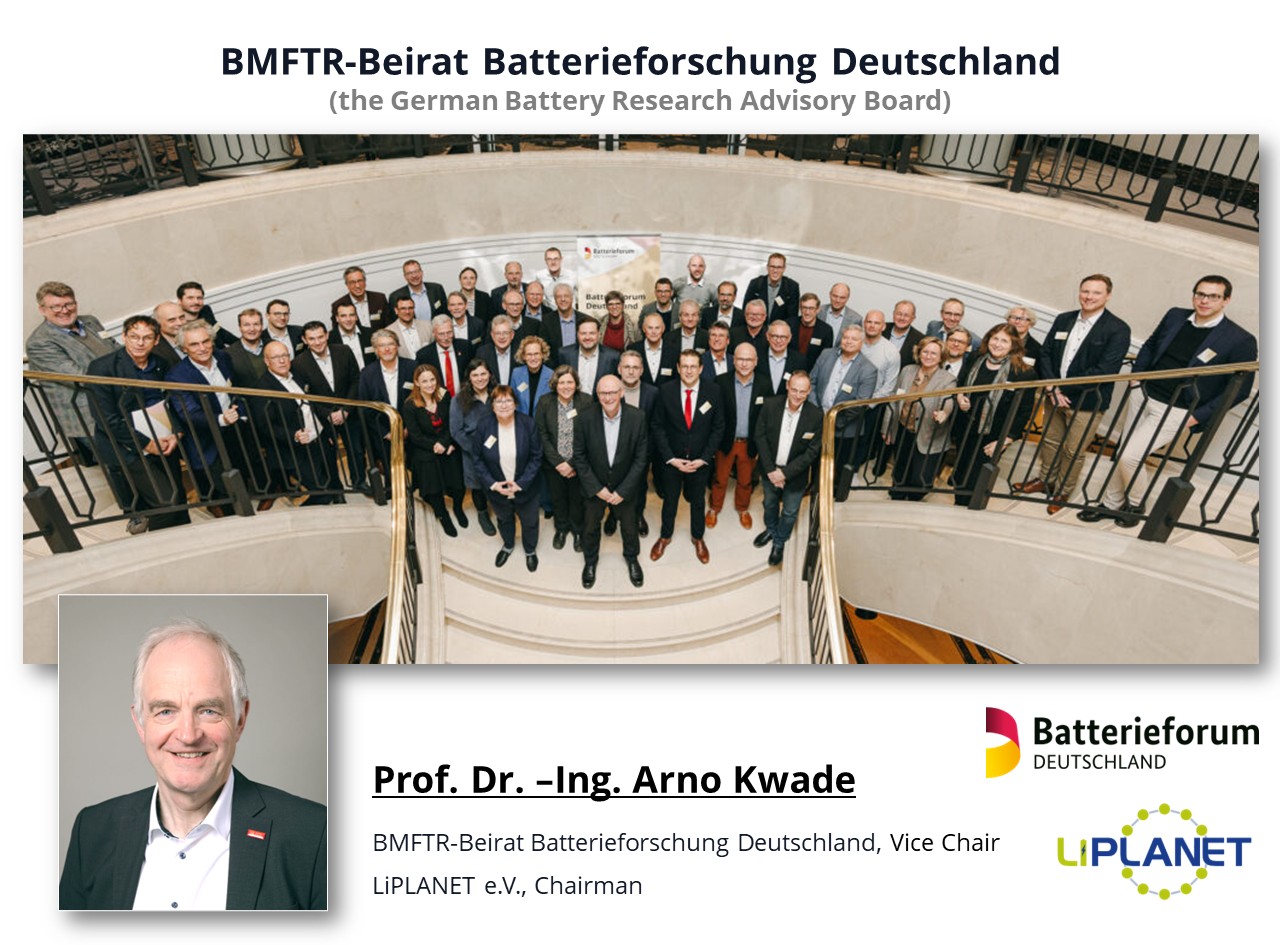
On July 17, 2026, LiPLANET had the privilege of presenting its strategic update for “LiPLANET 2.0” to the Beirat Batterieforschung Deutschland. This high-level advisory body, composed of 68 leading representatives from industry and research, provides strategic guidance to the Federal Ministry (BMFTR) on electrochemical energy storage research.
The vision, presented by Prof. Dr.-Ing. Arno Kwade (1st Chairman of LiPLANET e.V.), emphasized the permanent institutional nature of LiPLANET, not restricted by project durations. Central to the presentation was the network’s decentralized infrastructure for bridging the “Valley of Death” between lab-scale research (TRL 4) and industrial production (TRL 9).
The LiPLANET 2.0 Operational Vision: The “Airbus Model”
A cornerstone of the presentation was the “Airbus Model” for battery production. This hybrid, decentralized framework pools specialized local competencies across Europe—such as anode production in one region, cathode in another, and assembly at a third site—to produce high-performance demonstrators like sodium-ion or solid-state batteries. This model is designed to:
- De-risk EU-based innovations by avoiding redundant capital expenditure (CAPEX).
- Produce high-performance prototypes that facilitate market entry for SMEs and startups.
- Manage intellectual property (IP) through clear, fair joint agreements to foster cross-border trust.
Reinforcing Strategic Ecosystem Ties (BEPA & BATT4EU)
The presentation highlighted the deepening connection between LiPLANET, BEPA, and BATT4EU to address the critical industrial ramp-up phase. European manufacturers currently face high scrap rates, yield gaps, and process instability during scale-up. LiPLANET serves as the essential technical bridge and an integration node for the iterative co-optimization of:
- Materials and Equipment: Acting as testbeds for European machinery before industrial deployment.
- Cell Assembly and Performance: Utilizing pilot lines to validate and stabilize processes before massive capital commitments are made to Gigafactories.
Ensuring Long-Term Research Sustainability
Drawing from the December 2025 Graz Workshop (hosted by Clusters, Battery Heroes and COLLABAT), LiPLANET addressed the fragmentation often seen when project funding ends. The ecosystem has explicitly requested LiPLANET to lead inter-cluster coordination to ensure that technical protocols and networks are preserved and handed over to subsequent initiatives.
Support for “A Battery Deal for Europe”
LiPLANET reaffirmed its pledge and strong support for A Battery Deal for Europe, a joint vision by RECHARGE and BEPA built on four pillars:
- Innovate: Scaling clean and modular production models.
- Produce: Providing predictable, performance-linked revenues and CAPEX support.
- Buy: Stimulating demand through local content requirements and sustainability-weighted tenders.
- Secure: Strengthening trade defense and strategic material partnerships.
Key Initiatives and Collaborative Tools
- STORE-LINES: A joint CSA proposal with StoRISE (led by KIT) and in collaboration with BecoSearch/KLiB aimed at removing legal and administrative bottlenecks to provide a single energy storage access ecosystem.
- Seal of Approval: A rigorous certification framework utilizing the BecoSearch/KLiB platform to verify quality and sustainability standards, providing trust for SME clients and a competitive edge for member pilot lines.
- Learning Factories: The launch of dedicated hardware-based training centers (like BLB+) to professionalize the workforce through hands-on industrial training.
Fruitful Strategic Discussion with Beirat Members
The presentation was followed by a vibrant exchange where Beirat members praised LiPLANET as a “concrete forward-looking” initiative for European industrialization. The discussion emphasized the need for a “level playing field” and the pooling of forces to solve challenges at EU level. Members identified the importance of establishing the “One-Stop-Shop” (mandated by High-Tech Agenda Germany (HTAD) Milestone Bat-R&D7) to simplify access to the infrastructure for SMEs and startups by 2030.